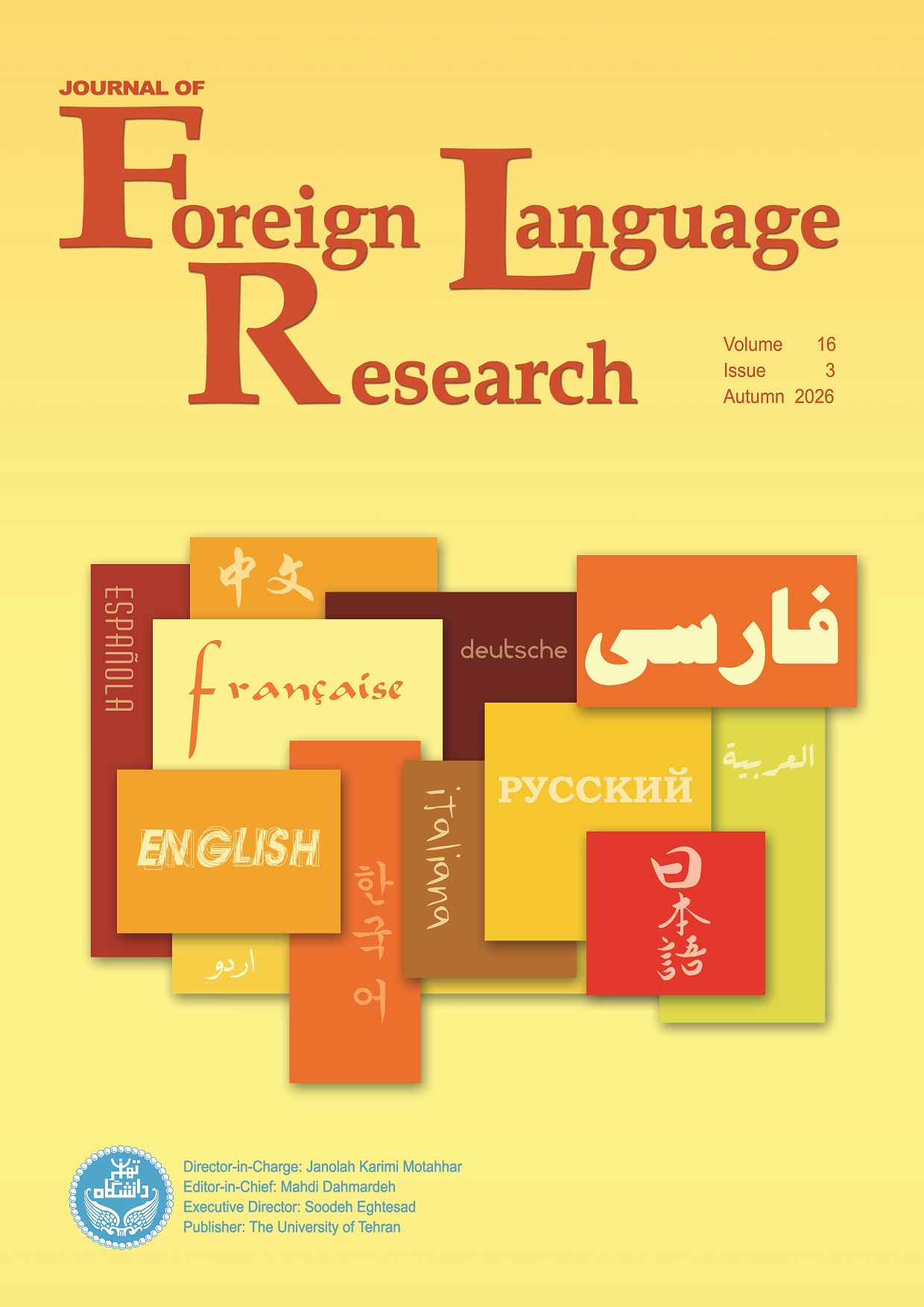
Journal of Foreign Language Research

Journal of Foreign Language Research

Number of Volumes 16
Number of Issues 47
Article View 809,794
PDF Download 645,883
View Per Article 1704.83
PDF Download Per Article 1359.75
             --
Number of Submissions 1,200
Acceptance Rate 23
Time to Accept (Days) 30

Journal of Foreign Language Research is a reviewed quarterly publication concerned with appropriate aspects of applied linguistics, language teaching and testing, and translation. JFLR is a quarterly open access publication, which publishes of original research articles, review articles. There is no Article Processing Charge (APC) In this journal.

  • Concessionaire: University of Tehran
  • Country of Publication: IRAN
  • Director-in-Charge: Janolah Karimi Motahhar
  • Editor-in-Chief: Mahdi Dahmardeh
  • Publisher: The University of Tehran
  • Format: Electronic
  • Print ISSN: 2588-4123
  • E-ISSN: 2588-7521
  • Available from: 2011
  • Frequency: Quarterly
  • Publication Dates: Trimestral
  • Advance Access: Open access
  • Language: Persian with English abstract and bibliography – Second Language: one of these English, French or German.
  • Scope: Applied Linguistics, Linguistics, Translation, CALL, MALL
  • Article Processing Charges: Processing Fee: 2/000/000 Rials  / Publication Fee: 4/000/000 Rials
  • Type of Journal: Research Article
  • Open Access: Yes
  • Using similarity-finding software (Samim Noor) in reviewing and refereeing articles
  • Indexed & Abstracted: ISC-DOAJ-MIAR-SID-GOOGLE SCHOLAR- NOOR MAGS- MAGIRAN-NLAI
  • Policy: Double Editorial Review, Double Blind Peer Review
  • Review Time: 1 month
  • Contact E-mail: jflr@ut.ac.ir
  • Alternate E-mail: jflr.ut.ac.ir@gmail.com

Keywords Cloud

  • Translation
  • English language
  • \"
  • EFL Learners
  • Culture
  • Writing
  • Dynamic Assessment
  • Persian language
  • Reading comprehension
  • Iran
  • Russian language
  • Error Analysis
  • Language Teaching
  • Motivation
  • pronunciation
  • bilingualism
  • Evaluation
  • Curriculum
  • teacher education
  • Intercultural Competence
  • technology
  • arabic language
  • Iranian EFL learners
  • English language teaching
  • Foreign Language Teaching
  • Language proficiency
  • Language
  • gender
  • English
  • English Language Learning
  • Cultural Identity
  • Teacher
  • Feedback
  • persian
  • Teaching experience
  • Text
  • students
  • Cognitive linguistics
  • discourse
  • Spanish language
  • Cognition
  • critical thinking
  • teachers
  • EFL teachers
  • Linguistics
  • Attitude
  • age
  • Translation Studies
  • literary translation
  • Academic Writing
  • Foreign language
  • strategies
  • Grounded theory
  • Validity
  • German Language
  • EFL
  • Loanword
  • professional development
  • Self-assessment
  • Language Learners
  • ZPD
  • Meaning
  • textbooks
  • Discourse analysis
  • Corrective feedback
  • classroom discourse
  • Russian
  • Functional Linguistics
  • Sociolinguistics
  • collocation
  • listening comprehension
  • Grammar
  • Pedagogical Knowledge
  • Speech Acts
  • Textbook evaluation
  • Emotional intelligence
  • Chinese language
  • Pragmatics
  • borrowing
  • Accuracy
  • Think-aloud protocol
  • Teaching method
  • conceptual metaphor
  • anxiety
  • Self-regulated Learning
  • Written corrective feedback
  • Multiple intelligences
  • perception
  • Group Work
  • Recast
  • Communicative Competence
  • Challenges
  • learner autonomy
  • Zone of Proximal Development
  • Contrastive Linguistics
  • English for Specific purposes
  • Teachers&rsquo
  • Applied linguistics
  • Phonological Processes
  • Differential Item Functioning
  • Intercultural Communication
  • apology
  • Fluency
  • teaching
  • L2
  • Interculture
  • interference
  • Difference
  • Fairness
  • language testing
  • Globalization
  • s literature
  • Stop Motion Studio
  • EAP
  • assessment literacy
  • Language Anxiety
  • Education
  • Subgenre
  • collaborative learning
  • Phonological Awareness
  • language teacher education
  • Peer Feedback
  • French Language
  • \"self-regulation\"
  • comprehension
  • vocabulary learning
  • Skills
  • Japanese
  • assessment
  • reliability
  • Listening Performance
  • translator
  • body language
  • lexical inferencing
  • Input
  • textbook analysis
  • Italian language
  • Communicative approach
  • Semiotics
  • Revision
  • Digital Storytelling (DST)
  • introversion
  • teachers’ perceptions
  • semantics
  • textbook
  • Output
  • Phonetics
  • Error Correction
  • German as foreign language
  • Reading Skills
  • Metalinguistic feedback
  • Quran
  • \"EFL teachers\"
  • Intertextuality
  • interpreting
  • Formative Assessment
  • reflective journal
  • Music
  • Grammatical Accuracy
  • Language Skills
  • Translation Strategies
  • Translation Education
  • Functions
  • foreign language learning
  • Intercultural Communication Competence
  • classroom practice
  • grammatical competence
  • Cultural Intelligence
  • Speaking Proficiency
  • Virtual Teaching
  • Narrative Inquiry
  • Productive Skills
  • Computer
  • \"gender\"
  • linguistic
  • Elicitation
  • reading
  • English language learners
  • Persian Speakers
  • Typology
  • request
  • scaffolding
  • Language learning
  • Structuralism
  • language ideology
  • Creativity
  • Collaborative Writing
  • Markers
  • ChatGPT
  • world Englishes
  • Willingness to communicate
  • Substitution
  • \"Attitude\"
  • Artificial Intelligence
  • reflective teaching
  • Information and communication technology
  • Second language
  • Technological Pedagogical Content Knowledge
  • non-native teachers
  • Online Teaching